


Pack Smart – Choosing Sea Fishing Luggage That Actually WorksMy New Blog Title
Pack Smart – Choosing Sea Fishing Luggage That Actually WorksMy New Blog Title
Monday, August 17, 2026 - 0 Comments
Posted by Mick
Pack Smart – Choosing Sea Fishing Luggage That Actually Works
There are two occasions when you discover you've taken too much tackle sea fishing.
The first is halfway down a steep path to the mark.
The second is on the way back up.
And strangely enough, it's always heavier on the way back.
Over the years I've seen sea anglers arrive carrying enough equipment for a fortnight aboard a North Sea trawler, only to spend the entire session using the same packet of hooks, three leads and one rig.
So this time the Old Sea Dog is having a look at something that doesn't catch fish, but can make a day's fishing considerably easier — sea fishing luggage.
A Fishing Bag Isn't Just a Fishing Bag
Freshwater anglers can sometimes get away with an ordinary tackle bag.
Sea fishing is rather less forgiving.
Saltwater, spray, wet rocks, sand, bait and the British weather all conspire to attack whatever you take with you. Salt in particular is extremely good at finding metal fittings and zips and persuading them that they'd rather not work anymore.
That's why purpose-designed sea fishing luggage often features things such as water-resistant materials, reinforced or waterproof bases and saltwater-resistant zips. Those aren't merely nice extras — they're worth having when your bag regularly ends up sitting on a wet deck or beach.
Hard Bag or Traditional Tackle Bag?
There's no single right answer.
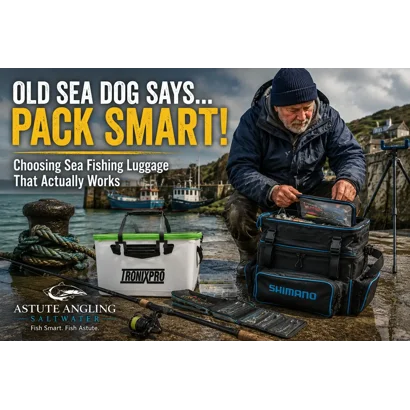
The hard-sided or semi-rigid style of sea bag, like the Tronixpro example pictured, is particularly useful aboard a boat. They're easy to put down, easy to rummage through and the wipe-clean construction makes a great deal of sense when everything around you is wet, salty or covered in bait.
For shore fishing, I often prefer something with more organisation.
A traditional compartmented tackle bag, such as the Shimano style pictured, gives you separate homes for terminal tackle, rigs, tools, spare line and all those little bits and pieces that otherwise migrate mysteriously to the very bottom of your bag.
If you move around a lot, however, a rucksack starts making more sense. Carrying the weight properly across both shoulders leaves your hands free for rods, tripod and whatever else you've decided you absolutely couldn't leave at home.
The Old Sea Dog's Rule: Don't Carry What You Don't Use
This one took me years to learn.
Before every trip, ask yourself:
“Am I genuinely likely to use this today?”
If you're going uptiding from a boat, you probably don't need half the contents of your beach-fishing box.
If you're lure fishing for a couple of hours, you don't need enough terminal tackle to open a small shop.
A smaller, properly organised selection usually means less weight, less rummaging about and more time actually fishing.
That doesn't mean travelling unprepared. Spare traces, hooks, leads, swivels, line and a few essential tools should always have their place.
It means leaving the kitchen sink at home.
Give Everything a Home
Organisation becomes particularly important when the fishing suddenly comes alive.
There's nothing worse than knowing you've got exactly the right rig somewhere in the bag while everybody around you is catching fish.
Keep rigs together, terminal tackle together and tools somewhere immediately accessible. Small tackle boxes and rig wallets inside a larger bag work particularly well.
And keep wet, salty used tackle away from clean tackle whenever possible. Salt left on hooks, swivels and other metal components encourages corrosion, so putting a dripping used rig straight back amongst your fresh tackle isn't doing either of them any favours.
Boat Anglers – Think About the Deck
A boat bag has another job that doesn't matter quite so much on dry land.
It needs to stay where you put it.
Decks get wet. Boats move. Anglers stumble around while trying to follow fish.
A reasonably compact bag with a stable base is therefore often more useful than a huge soft carryall. You want something that can sit beside you without continually collapsing, sliding around or becoming an obstacle.
And remember that space aboard charter boats can be limited. Turning up with luggage normally associated with an expedition to Everest won't necessarily make you popular with the skipper.
Look After the Bag and It'll Look After Your Tackle
Sea fishing luggage needs a little maintenance too.
After a particularly wet or salty session, empty the bag and remove any sand, bait and rubbish. Give salt-exposed areas and especially the zips and fittings a rinse with fresh water, then allow everything to dry thoroughly before putting the tackle away.
Salt and sand left around zips can eventually cause corrosion or jamming, even on equipment designed for marine use.
And whatever you do, don't zip a damp bag shut and throw it into the shed for six months.
You'll remember why when you open it again.
So, What Should You Buy?
Think about how you actually fish, rather than buying the biggest bag you can find.
Boat fishing: A sturdy, water-resistant bag with a stable base and easy access is hard to beat.
Beach fishing: A rucksack or larger compartmented tackle bag makes carrying equipment to distant marks much easier.
Mobile lure fishing: Keep things small and light. A compact shoulder bag or rucksack with a few organised lure boxes is usually plenty.
Mixed fishing: A good general-purpose tackle bag with separate compartments gives you the flexibility to change what you carry depending on the trip.
The best sea fishing luggage isn't necessarily the biggest, most expensive or the one with seventeen pockets and somewhere specifically designed to keep your sandwiches.
It's the one that carries what you actually need, keeps it organised and survives being repeatedly introduced to saltwater.
Because at the end of a long session, when you've got a rod in one hand, a tripod in the other and a climb back to the car ahead of you...
every unnecessary pound in that tackle bag feels like ten.
— The Old Sea Dog
Fish Smart. Fish Astute.
Optional, for replies
No comments posted yet, check back soon.


